Stablecoin Market Cap and Total Supply
Total stablecoin supply across chains, day by day, with its distance from the all-time high and the coins and chains behind it.
Multi-chainEthereumTron+4Monitor the coins you hold, accept or issue by issuer, chain and currency, with lineage your risk, finance and model-validation teams can trace from the report to the block.
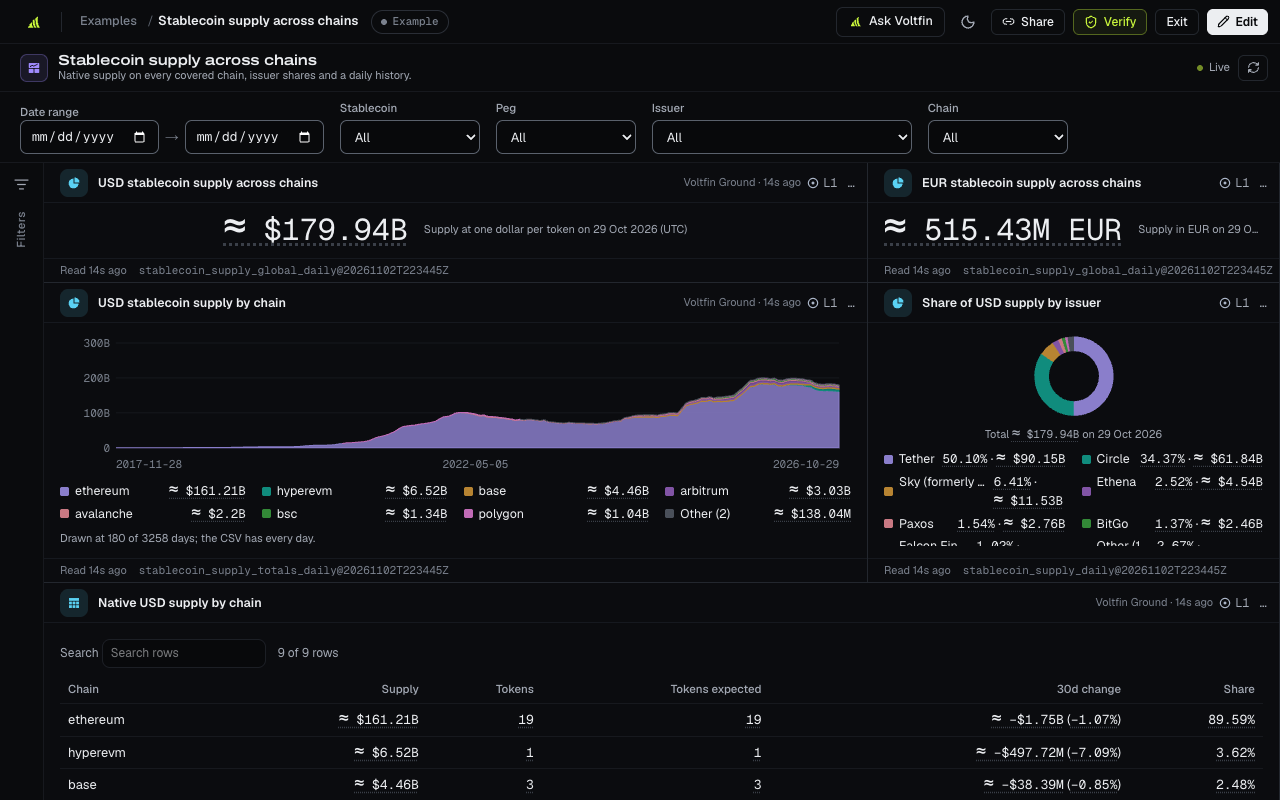
Captured 10 Nov 2026. The live example reads today's figures, each with its receipt.
Open full screen →Prudential rules ask banks to classify each stablecoin and to know their exposure to it. That starts with facts: who issues it, where it is natively issued and how its supply is moving.
Every row in Voltfin keeps its receipt, from the published dataset back to the contract and the block, so an aggregate is traceable rather than asserted.
Boards, tables and dated reports are built in one workspace, on one set of numbers, for treasury, risk and finance alike.
Each workflow with a live example: the published data as Studio shows it, every figure opening its receipt.
The problemA coin's risk changes with its issuer, its chains and its supply trend. Limits and classifications need all three.
With VoltfinSupply for each coin you hold or accept, by chain, with its 30-day change and bridged copies apart, on a board you can filter and share.
USDT across chains
Open full screen →The problemEuro stablecoins are small next to dollar ones, and spread across issuers and chains, so their footprint is easy to miss.
With VoltfinA euro coin's native supply on each chain, with its 30-day change and bridged copies apart, read the same way as dollar coins, for euro settlement and deposit-token planning.
EURCV across chains
Open full screen →The problemRisk data has to be aggregated completely and accurately, and reviewers ask where each input came from.
With VoltfinA table of supply by token, chain and day in which every row opens its receipt and exports with it.
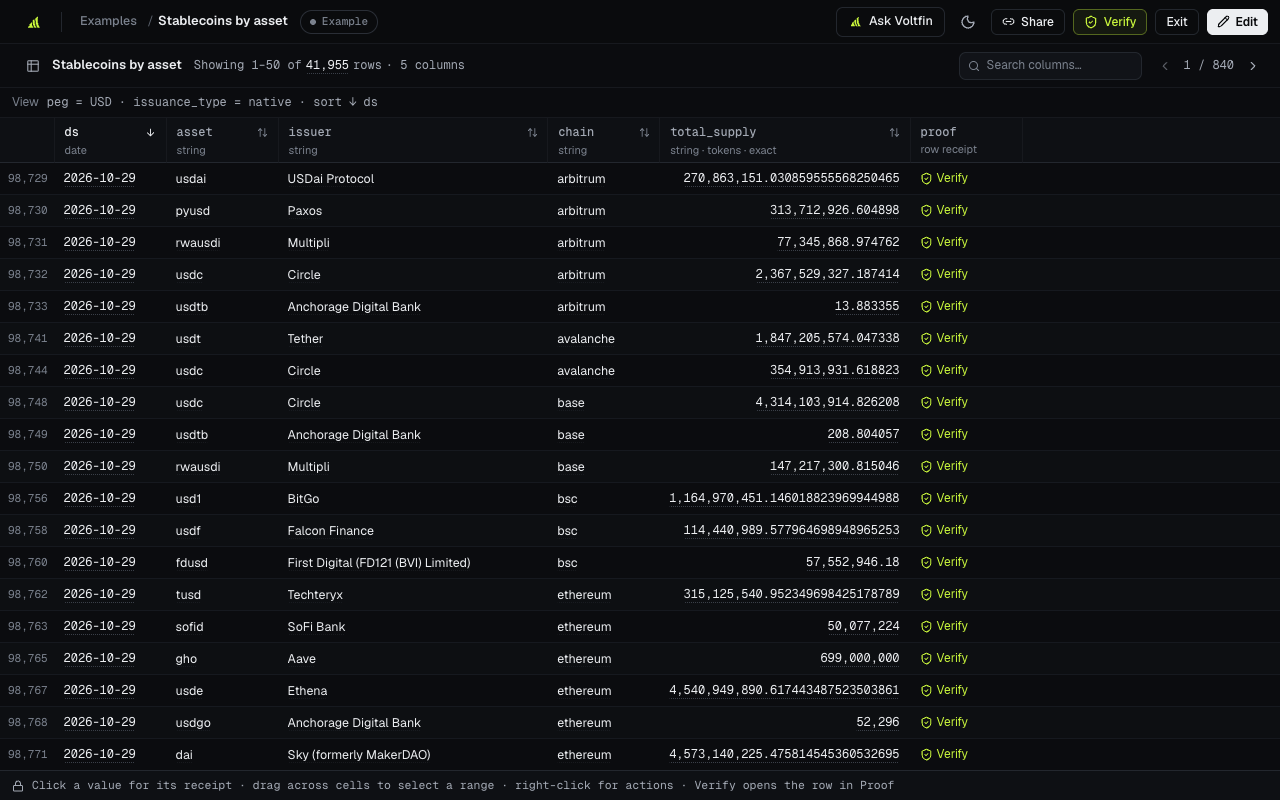
Captured 10 Nov 2026. The live example reads today's figures, each with its receipt.
Open full screen →Short summaries for orientation, not legal advice. Each links to its source.
Its implementation date is 1 January 2026. A stablecoin gets the lighter Group 1b treatment only if it passes a redemption risk test and its issuer is supervised.
Read the source BCBSPrinciples for aggregating risk data completely, accurately and quickly, with lineage a supervisor can follow.
Read the source United StatesLets subsidiaries of insured banks issue payment stablecoins under federal supervision, with one-to-one reserves.
Read the source100 of the 391 apps in the library are written for these teams. Each shows its blueprint now and its data plan.
Browse all 391 appsTotal stablecoin supply across chains, day by day, with its distance from the all-time high and the coins and chains behind it.
Multi-chainEthereumTron+4Each issuer's share of dollar stablecoin supply today and over time, from Tether and Circle to the newer issuers.
Multi-chainEthereumTron+1Every tracked stablecoin with its issuer, peg, backing, chains and circulating supply, in one table you can sort and filter.
Multi-chainEthereumTron+2How much USDT lives on Tron and how much of it moves each day: supply, issuance, transfers, sending accounts and transfer sizes.
TronWhere USDT and USDC each circulate chain by chain, and how the gap between Tether's and Circle's dollar coins changes over time.
Multi-chainEthereumTron+4Every USDT and USDC mint and burn as it lands, by chain and by transaction, with daily net issuance for both coins.
Multi-chainEthereumTron+1Tell us what you report on, or start free and open any example in Studio.