Bitcoin Quantum Risk: BTC in Exposed Public Key Addresses
Bitcoin held in outputs whose public keys are already visible on-chain, split by script type and tracked day by day.
BitcoinEvery figure carries its receipt: the contract, the block and the read behind it. Reconcile tokens outstanding across chains and hand over evidence anyone can check again, not a screenshot.
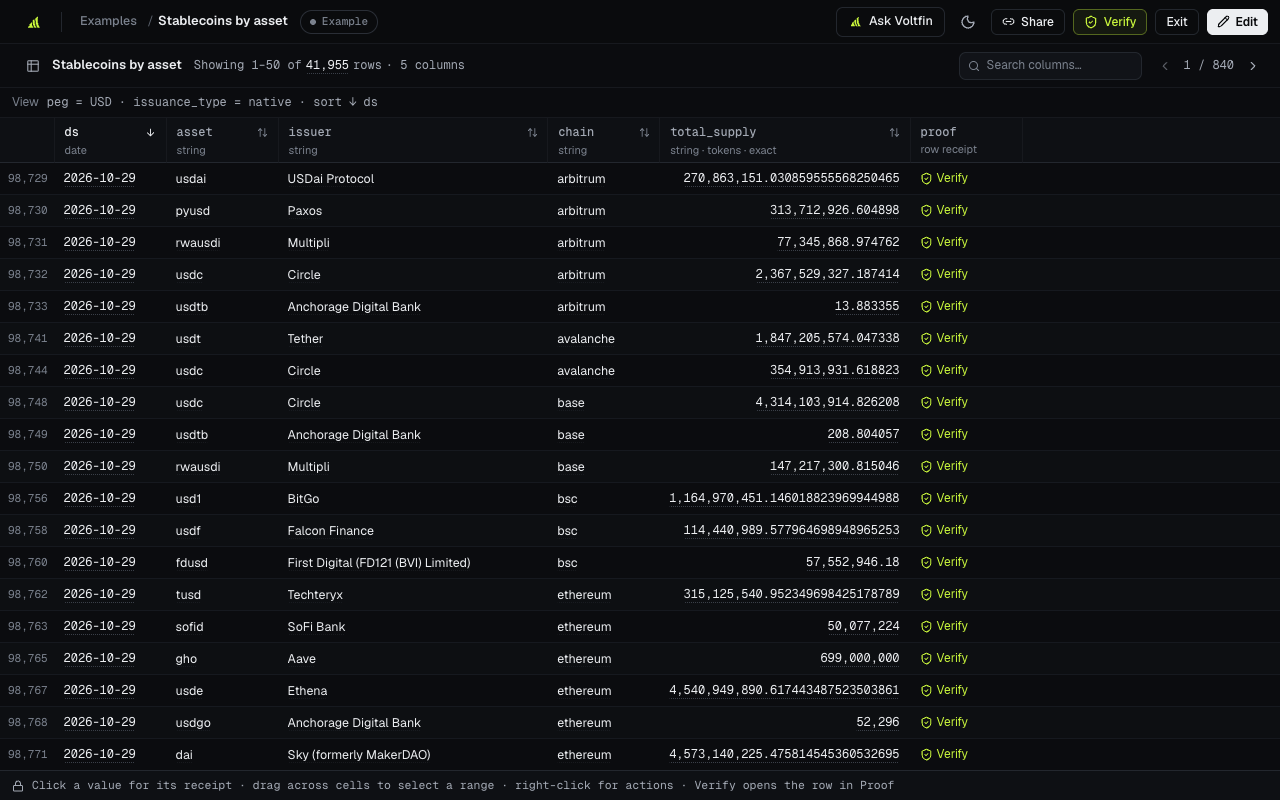
Captured 10 Nov 2026. The live example reads today's figures, each with its receipt.
Open full screen →Before relying on a number, an auditor has to know how it was obtained. Voltfin answers on every figure: the dataset version, the row, the contract and the block it was read at.
Supply is read from each contract's totalSupply() at the last block of every UTC day, on 9 chains. Bridged copies are kept apart, so a coin is never counted twice.
Verify lists every receipt behind a page with its proof level and how to repeat the read yourself, and live contract reads can be re-run in the browser against independent node operators. There is nothing to install and nothing to take on trust.
Each workflow with a live example: the published data as Studio shows it, every figure opening its receipt.
The problemMonth-end reports state how many tokens are outstanding. Tying that figure to the chain means reading every deployment, on every chain, at the same moment.
With VoltfinVoltfin publishes each coin's native supply on every covered chain at the last block of each UTC day, with bridged copies apart, so the total matches what the issuer can redeem.
USDC outstanding across chains, bridged copies apart
Open full screen →The problemA number copied from a dashboard is hard to rely on. The reviewer cannot see how it was read, or read it again.
With VoltfinOpen any figure to see its receipt: the dataset version and row, the contract, the method and the block. Verify lists every receipt on the page with its proof level and how to repeat the read.
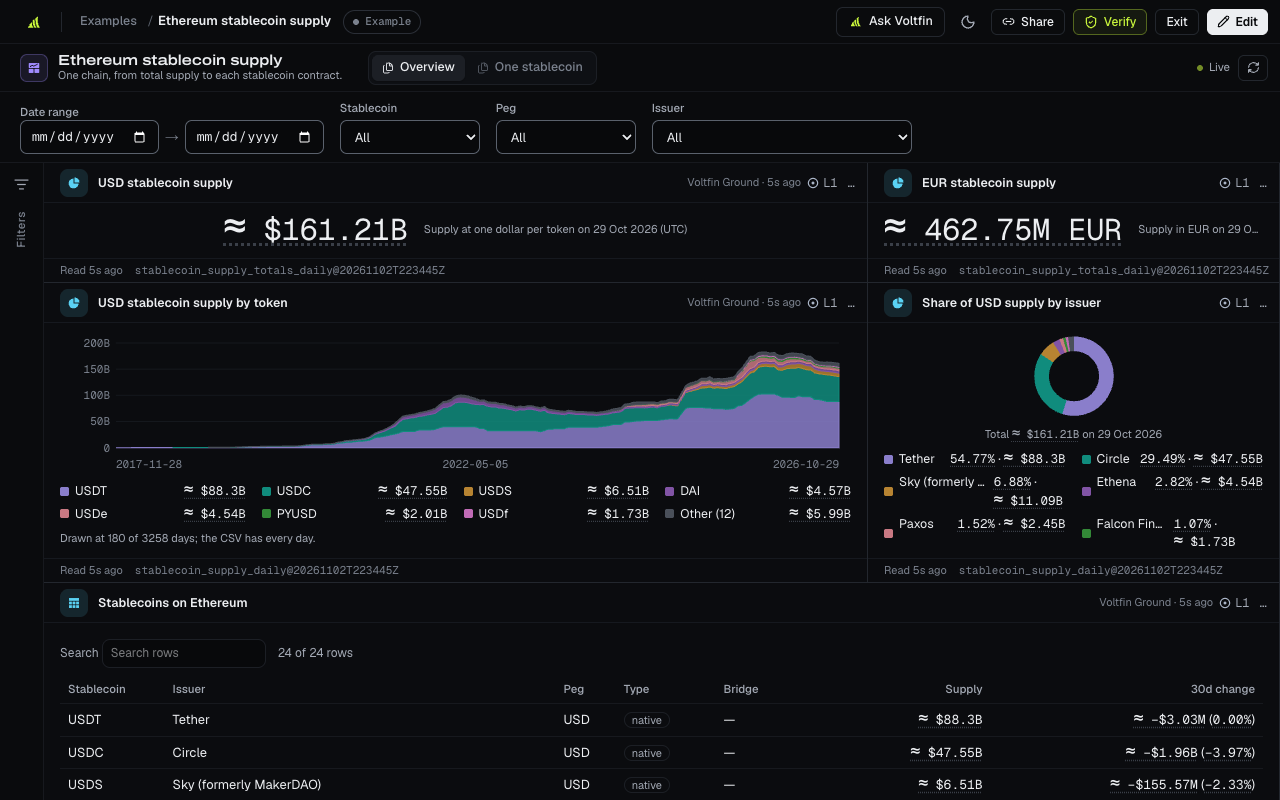
Captured 10 Nov 2026. The live example reads today's figures, each with its receipt.
Open full screen →The problemLimits are set per issuer and per chain, but market-wide figures rarely show either split.
With VoltfinEach issuer's share of USD supply and the split of supply by chain on the latest complete day, with the 30-day change, filtered to the coins and chains you hold.
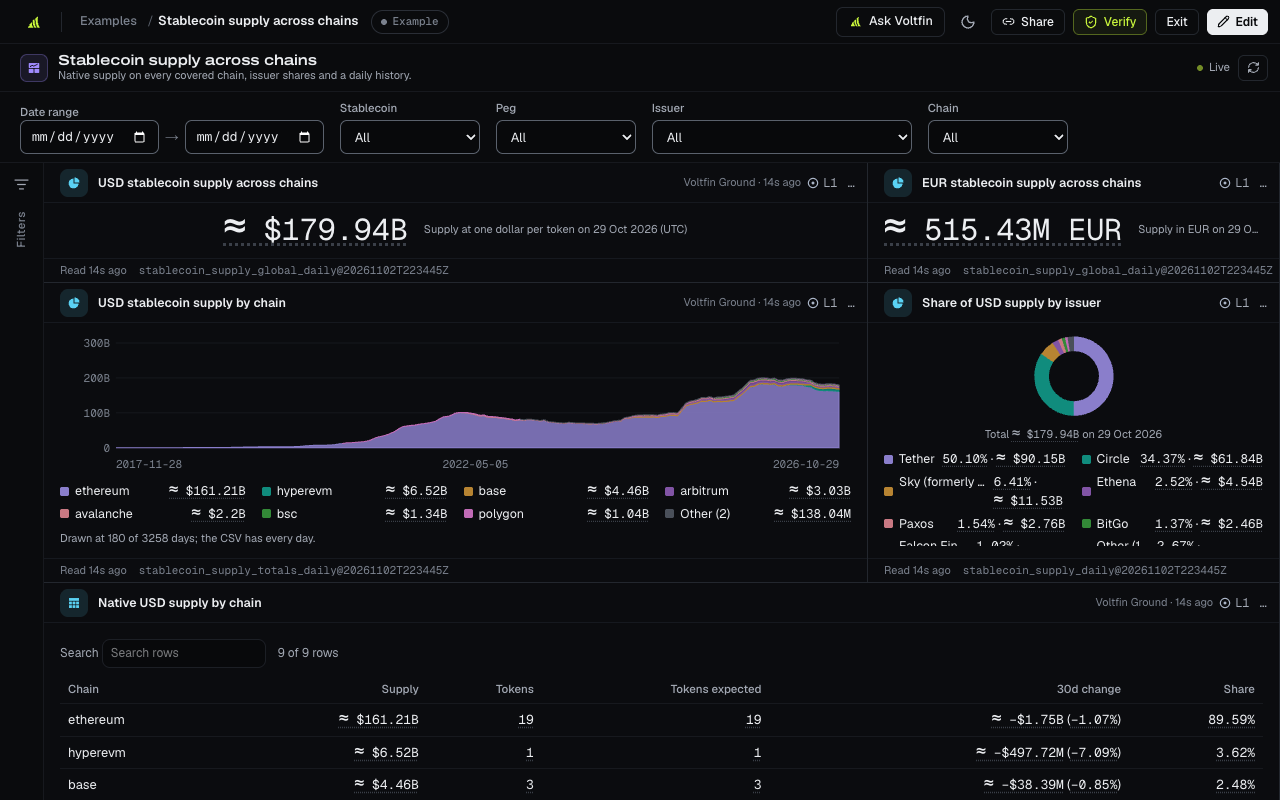
Captured 10 Nov 2026. The live example reads today's figures, each with its receipt.
Open full screen →Short summaries for orientation, not legal advice. Each links to its source.
Payment stablecoin issuers publish the composition of their reserves every month, examined by a registered public accounting firm. It takes effect by January 2027.
Read the source European UnionIssuers of asset-referenced tokens above €100 million, and of e-money tokens in a non-EU currency, report each quarter: holders, value issued, reserve size and daily transactions.
Read the source AssuranceCriteria for an issuer's report of tokens outstanding against the assets held to redeem them.
Read the source73 of the 391 apps in the library are written for these teams. Each shows its blueprint now and its data plan.
Browse all 391 appsBitcoin held in outputs whose public keys are already visible on-chain, split by script type and tracked day by day.
BitcoinThefts attributed to North Korea-linked groups, what their attributed wallets still hold and how the funds move across chains.
Multi-chainEthereumBitcoinWhat wallet drainers take each month, on which chains and through which signatures: approvals, permits, NFT listings and delegations.
Multi-chainEthereumEvery spender that can still move a wallet's tokens or NFTs, with the allowance, when it was granted and the transaction that set it.
Multi-chainOn-chain prices of major stablecoins from DEX pools and oracle feeds: how far each trades from its peg now and how deep past depegs went.
Multi-chainEthereumBase+2Check whether an address is frozen by Tether or Circle, and follow how much USDT and USDC the issuers freeze, unfreeze and destroy.
Multi-chainEthereumTronTell us what you report on, or start free and open any example in Studio.